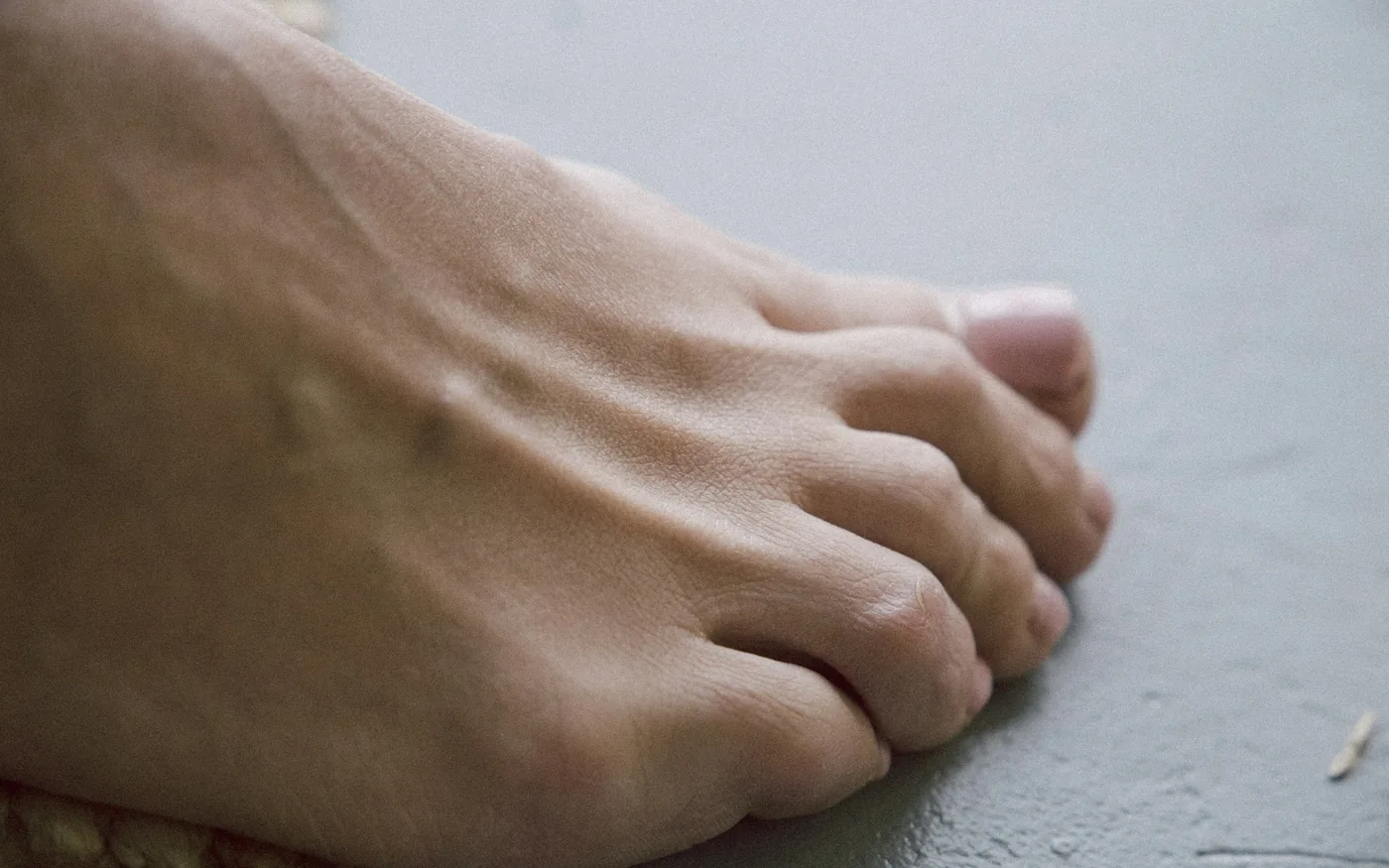
This site now has three articles about pain at the base of the big toe. Bunions drift sideways, gout arrives overnight and red, and this one stiffens.
It also has the opposite footwear advice to the other two, which is worth getting right.

The three big toe problems
| Hallux rigidus | Bunion | Gout | |
|---|---|---|---|
| Onset | Gradual, over years | Gradual, over years | Hours, often overnight |
| The bump | On top of the joint | On the inner side | None — the joint swells |
| Toe direction | Straight | Drifts towards the second toe | Unchanged |
| Movement | Markedly stiff upward | Usually preserved | Too painful to test |
| Worst when | Pushing off, going uphill | In narrow shoes | At rest, acutely |
| Footwear answer | Stiff sole | Wide toe box | Not a footwear problem |
Why bending is the problem
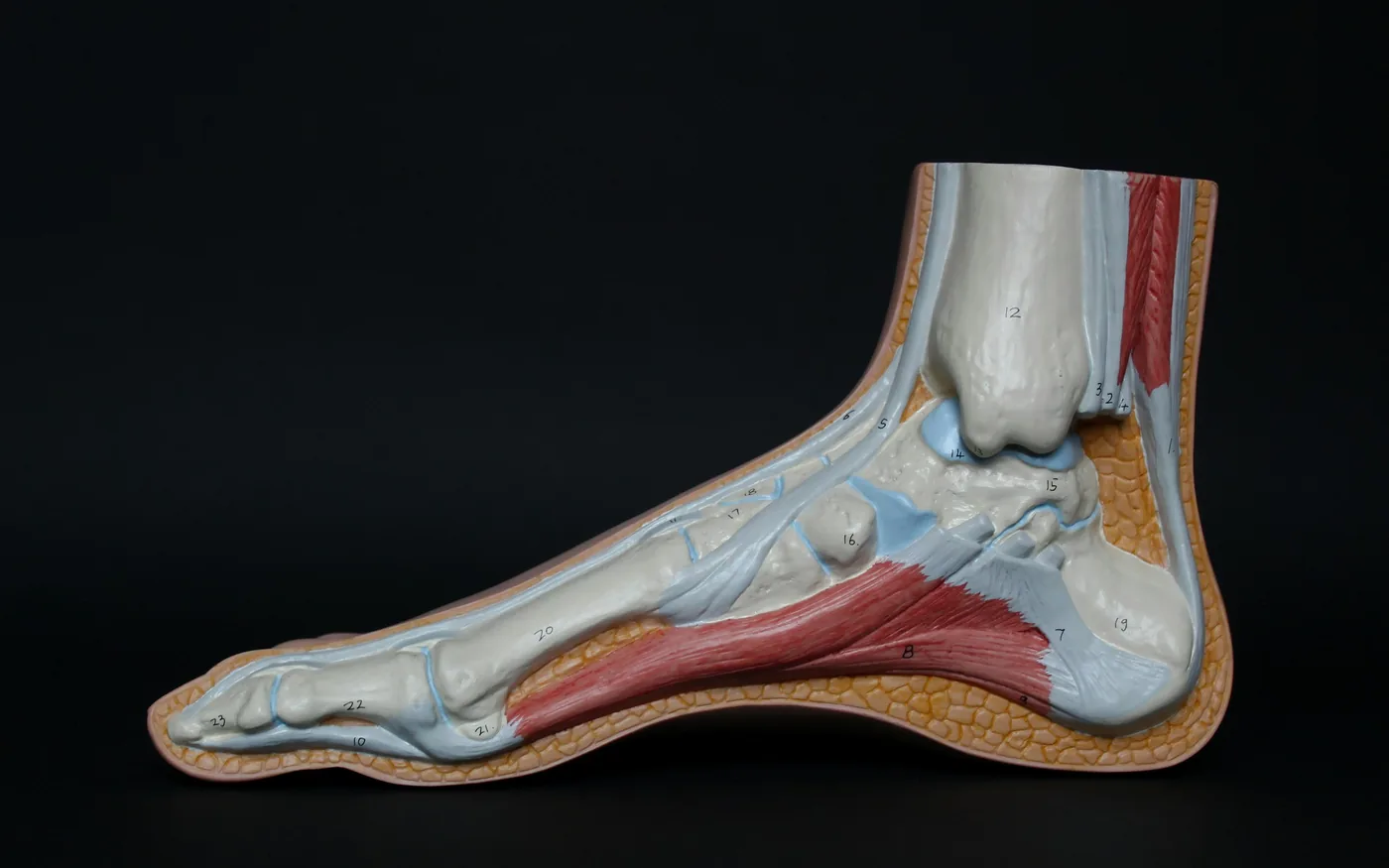
Every step asks the big toe joint to bend upward as the heel lifts. In a healthy foot that is around sixty degrees of movement, and it happens thousands of times a day without notice.
When the joint surface has worn and a ridge of bone has formed on top, that upward bend is exactly the movement that jams the joint. Hence the pain at push-off, the pain going uphill, and the pain in any position that forces the toe up.
The stiff sole, and why it works
If the pain comes from bending the joint, the useful intervention is a shoe that does the bending for you.
A stiff sole limits how far the joint has to move. A rocker shape — a sole curved upward at the front — goes further, rolling the foot through the step so the toe barely bends at all. Together they are the most effective conservative measure available for this condition.
It is a genuinely different requirement from a bunion, where width is everything and sole stiffness is largely irrelevant. Buying the wrong one of those is a common and understandable mistake.
A cheaper version
New shoes are not always the answer, and there is an inexpensive alternative worth knowing about.
A rigid insert placed under the big toe — often a thin carbon fibre plate, sometimes a firm extension under that one toe — achieves much of the same effect inside a shoe you already own. It is the sort of thing a podiatrist supplies routinely, and it is worth asking about before replacing a wardrobe.
UT Southwestern Medical Center publishes patient material on foot and ankle arthritis if you want to read further.
What helps, in order
Ranked by how much difference each makes, which is not the order people usually try them in.
| Measure | How much it helps | Note |
|---|---|---|
| A stiff-soled shoe | Most of all | A rocker sole better still |
| A rigid insert | Nearly as much | Works inside shoes you already own |
| Avoiding deep toe bend | Meaningful | Kneeling, deep squats, some yoga positions |
| Reducing hill walking for a while | Moderate | Uphill forces the most toe extension |
| Anti-inflammatories | Short-term | Ask a pharmacist what suits you |
| Injection | Variable, temporary | A doctor conversation, not a first step |
What not to bother with
- Stretching the toe into a deeper bend. The range is limited by the joint, not by tight tissue, and forcing it provokes.
- Toe spacers. Useful for nothing here — the toe is not drifting sideways.
- Very flexible shoes. Minimal and highly flexible soles are precisely the wrong direction.
- Waiting for it to loosen up. It does not, and the footwear change works whether or not the joint changes.
How it usually progresses
Slowly, and not always to the worst case.
It generally begins as a loss of upward movement with pain only at the extremes — sometimes called hallux limitus — and some people stay there for years. Where it progresses, the range narrows further and the bony ridge on top becomes more prominent, at which point shoes start rubbing on it as well.
Two practical consequences. Getting the footwear right early is worth doing rather than waiting until it is bad, and a stiff toe that is not especially painful does not need treating at all.
Where acupuncture fits
For comfort, and the joint stays exactly as it is.
Needling and soft tissue work around the forefoot and calf can ease pain and the compensatory tightness that develops when you have been walking around a sore toe for months. That is a reasonable and modest contribution.
As with bunions and Morton’s neuroma, we would rather you spent the first $75 on the shoes.
When to see a doctor
See a doctor for a joint that becomes red, hot and swollen, particularly with fever — that is more likely gout or infection. Also for sudden severe pain rather than gradual, for numbness in the toes, for a wound over the joint, or for pain that footwear changes no longer control.
Booking a session in Beverly
Acupuncture is $75 a session, massage is $45 for 30 minutes and reflexology is $65 — all on our rates page.
See also bunions, Morton’s neuroma and plantar fasciitis. Browse all our articles or get in touch.
Frequently asked questions
What is hallux rigidus?
Arthritis of the joint at the base of the big toe. The joint stiffens, a bony ridge often forms on top of it, and bending the toe upward becomes painful — which is exactly what walking asks it to do at push-off.
How is it different from a bunion?
A bunion drifts the toe sideways and produces a bump on the inner side of the foot. Hallux rigidus keeps the toe straight, produces a bump on top, and limits how far the toe bends upward. The footwear advice for the two is different.
Why does a stiff sole help?
Because the pain comes from bending the joint. A stiff sole, particularly with a rocker shape, lets the foot roll through a step without the joint having to bend as far. It is the single most useful change available.
Will exercises straighten it out?
No. This is a joint that has stiffened, and no amount of stretching restores the range. Forcing the toe into deep bends generally makes it more painful rather than more mobile.
Does it always end in surgery?
No. Many people manage indefinitely with the right footwear. Surgery exists — trimming the bony ridge, or fusing the joint — and is for pain and function that footwear no longer controls.
This article is general information, not medical advice. Acupuncture is intended to work alongside the care of your doctor, not to replace it. Please speak to a clinician about any new, severe or changing symptom.