An ankle sprain is one of the most common injuries there is, and one of the most consistently under-rehabilitated. The injury itself usually settles. What does not settle by itself is the thing that causes the next one.
That is the argument of this whole article, so it is worth stating at the top.

What actually happened
In the large majority of cases the foot rolled inward and the ligaments on the outside of the ankle took the strain. They are the smaller, less robust set, which is why the injury goes that way rather than the other.
Alongside the ligament, something less visible is damaged: the position sense supplied by receptors in the joint and the surrounding tissue. Your ankle becomes slightly worse at knowing where it is, and that deficit does not resolve simply because the pain does.
When to get it looked at
| Sign | What it suggests | What to do |
|---|---|---|
| Cannot take four steps | Possible fracture | Get it assessed and imaged |
| Bone tenderness on either ankle bone | Possible fracture | Get it assessed |
| Obvious deformity | Fracture or dislocation | Emergency |
| Pain above the ankle, not at it | Possible high ankle sprain | Assessment; recovery is slower |
| Numbness or a cold, pale foot | Nerve or circulation | Urgent |
| Swelling, bruising, sore to walk on | An ordinary sprain | Start moving it |
The first two weeks
The advice here has changed materially in the last two decades, so it is worth reading even if you have sprained one before.
The old advice was rest and immobilise. The current evidence favours early functional treatment — movement and loading within comfort — for most sprains.
- Weight-bear as pain allows. Limping less beats crutches for longer, once a fracture has been excluded.
- Move it early. Gentle ankle circles and alphabet tracing within the first few days.
- Elevate and compress for the swelling, which is comfort rather than cure.
- Walk normally as soon as you can. A limp that outlives the injury becomes its own problem.
- Expect the bruising to travel down into the foot. Gravity, not deterioration.

The part almost everyone skips
Here is the thing this article exists to say.
A substantial proportion of people who sprain an ankle go on to either sprain it again or develop a persistently unstable ankle. Not because the ligament failed to heal, but because the position sense was never retrained.
Balance training reduces that risk. It is unglamorous, it takes a few minutes a day, and it is the single most valuable thing in this article.
| Stage | What it looks like | Progress when |
|---|---|---|
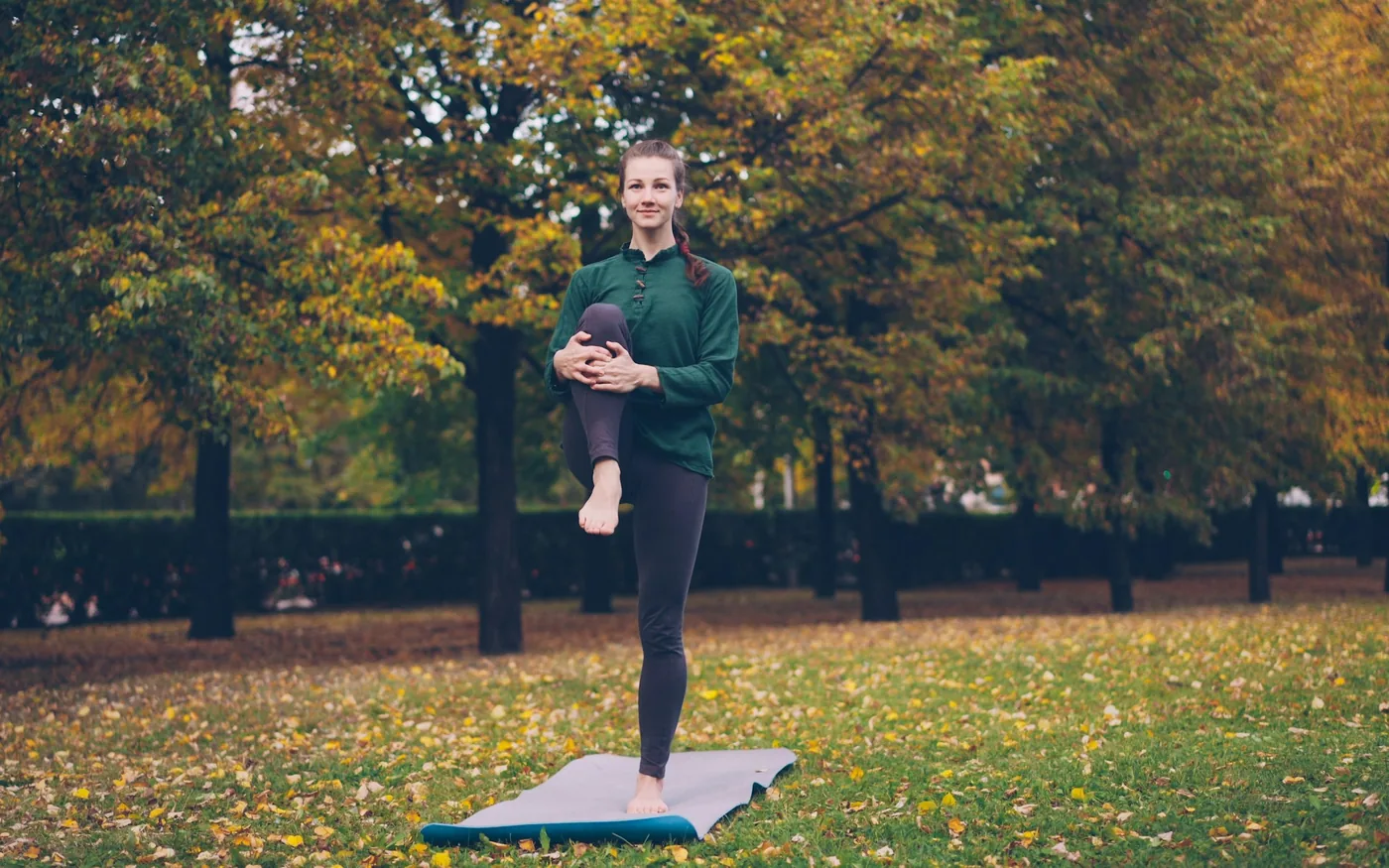
| Start | Standing on the injured leg, eyes open, near a wall | You can hold 30 seconds comfortably |
| Progress | Same, but with eyes closed | 30 seconds without touching down |
| Add movement | Balancing while reaching or passing a ball | Steady through the reach |
| Add surface | Standing on a cushion or folded towel | Steady for 30 seconds |
| Add impact | Hopping and landing on one leg | Controlled, no wobble |
| Return to sport | Sport-specific movement, plus a brace early on | All of the above are comfortable |
Why it matters so much here
Ankle sprains have a reputation as trivial, and the first one usually is. The problem is what follows.
A joint that no longer reports its position accurately will occasionally be caught out — on a kerb, in the dark, on uneven ground — and each subsequent sprain does a little more damage to both the ligament and the position sense. That is the loop that turns one bad afternoon into an ankle that gives way for years.
Breaking it takes a few weeks of deliberately unremarkable balance work, started while the ankle is still slightly sore rather than once it feels normal.
Coming back to sport
Time is a poor guide. Function is better, and there are three checks worth passing before you go back.
- Walk without a limp at normal speed.
- Hop on that leg ten times without pain.
- Balance on it for thirty seconds with your eyes closed, which is the one most people fail.
A brace or taping for the first months back reduces the chance of a repeat, particularly in court sports. Duke Health publishes patient guidance on ankle injuries if you want a fuller clinical picture.
Where treatment fits
More usefully than in most of the conditions on this site, though still not as the main event.
Reasonably, and early. Hands-on work and needling can help with pain and swelling in the first weeks, and there is some trial evidence for acupuncture in acute ankle sprain, though the studies are small.
What it does not do is retrain balance. Nothing does that except balancing, which is free.

When to see a doctor
See a doctor for inability to bear weight, bone tenderness on either ankle bone, obvious deformity, numbness, pain above the ankle joint rather than at it, or an ankle that keeps giving way months later.

Booking a session in Beverly
Acupuncture is $75 a session and massage is $45 for 30 minutes, $75 for 60 and $105 for 90 — all on our rates page.
See also Achilles tendinopathy, plantar fasciitis and shin splints. Browse all our articles or get in touch.
Frequently asked questions
Should I rest an ankle sprain?
Not for long. Early movement and weight-bearing as pain allows produce better outcomes than immobilising for most sprains. A day or two of protection is reasonable; a fortnight in a boot for an ordinary sprain is not.
When do I need an X-ray?
Broadly, if you cannot put weight through it for four steps, or if there is bone tenderness at specific points on either ankle bone. Clinicians use a set of rules for exactly this, and the rules are good at ruling fractures out.
How much swelling is normal?
A great deal, and it says surprisingly little about severity. Bruising can appear days later and travel down into the foot under gravity, which looks alarming and usually is not.
Why do people sprain the same ankle repeatedly?
Because a sprain damages the position sense in the joint as well as the ligament, and that does not recover on its own. Without balance retraining, a large proportion of people go on to recurrent sprains or a persistently unstable ankle.
How long until I can run again?
Depends on grade, but the useful test is function rather than time: you can walk normally without limping, hop on that leg without pain, and balance on it for thirty seconds with your eyes closed.
This article is general information, not medical advice. Acupuncture is intended to work alongside the care of your doctor, not to replace it. Please speak to a clinician about any new, severe or changing symptom.