Ask someone with patellar tendinopathy to point at the pain and they use one finger. That single detail separates it from most of the other things that make the front of a knee hurt.
It is a tendon problem, which means the rules are the ones this site has set out for every other tendon: load rather than rest, and judge it by tomorrow.

Or is it something else?
| Feature | Jumper’s knee | Other front-of-knee pain |
|---|---|---|
| Where | One point at the bottom of the kneecap | Diffuse suggests runner’s knee |
| Provoked by | Jumping, landing, decelerating, deep squats | Stairs and prolonged sitting suggest patellofemoral pain |
| During activity | Warms up and eases | Often builds instead |
| Next day | Worse | Not particularly |
| Swelling | Little or none | A swollen knee needs assessment |
| Age | Often teens to thirties, active | Adolescent pain at the shin bump is a different condition |
The pattern that identifies it
Location narrows it down. The behaviour over a day confirms it.
Three things together, and most people recognise all three once they are described.
- It warms up. The first few minutes hurt, then the session feels almost normal.
- It is worse the next morning. That delayed response is the tendon reporting on yesterday.
- It is dose-dependent. More jumping and landing yesterday means more pain today, fairly reliably.
That third point is what makes it manageable. A tendon that responds predictably to load can be trained deliberately, which is the whole basis of what follows.
Why rest fails
It is the natural response and it produces the most familiar story on this whole site.
Rest reduces the pain, which feels like progress. It also reduces the tendon’s capacity, so the sport that caused the problem is now further beyond what the tendon can handle than it was before you stopped.
The result is the pattern people describe as it never really going away: six weeks off, pain gone, back to training, pain back inside a fortnight. The same story appears in shin splints and Achilles tendinopathy for the same reason.
Who tends to get it
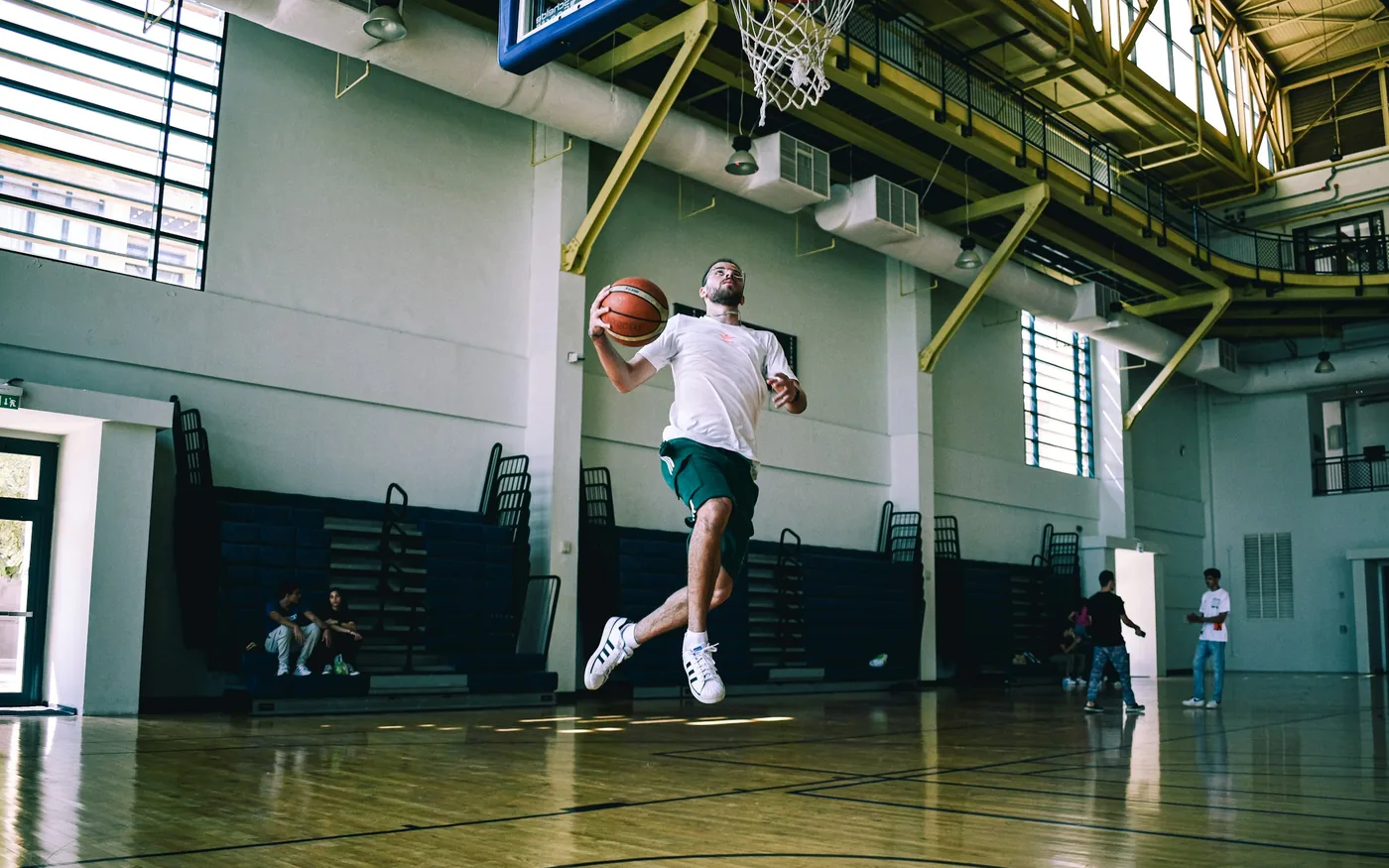
The name points at jumping sports and it is accurate as far as it goes, though the pattern is broader than basketball courts.
- Jumping and landing sports — basketball and volleyball above all, where repeated landing is the whole game.
- Sports with hard deceleration, which loads the tendon as much as jumping does and gets less attention.
- A sudden increase in squatting or lunging, including a new gym programme taken up enthusiastically.
- A return to sport after a lay-off at the level you left rather than the level you are at.
- Hard surfaces, which raise the landing forces without changing anything you notice at the time.
The common thread is a change in load rather than a level of load. Plenty of people jump a great deal for years without trouble; it is the fortnight when the volume doubled that shows up in the appointment book.
What the loading looks like
| Stage | What it involves | Why |
|---|---|---|
| Isometrics | Long holds against resistance, no movement | Often eases pain and is tolerable when movement is not |
| Heavy slow resistance | Squats and leg press, slow and controlled | Builds tendon capacity; the core of it |
| Reduce the provoking load | Less jumping and landing for now | Not zero — less |
| Energy storage work | Hopping and bounding, reintroduced later | Prepares for the demands of the sport |
| Return to sport | Graded, and after the above | Guided by capacity, not by the calendar |
| Avoid early | Deep knee bend and aggressive stretching | Compresses the irritated attachment |
The compression trap
Worth naming because the instinct is universal and wrong, and because it is the single most common way a sensible loading programme gets quietly undermined by the ten minutes of stretching somebody added to the end of it.
Stretching a sore tendon feels like the right response. At an attachment point, deep stretching presses the tendon against the bone underneath it, which irritates precisely the tissue that is already irritated.
This is the third time this trap appears on the site — it is the same mechanism as insertional Achilles pain and high hamstring tendinopathy. If a stretch feels good for thirty seconds and worse the next day, that is what is happening.
Where acupuncture fits
The same supporting role as every tendon on this site: reducing pain and surrounding muscular tension enough to make the loading programme tolerable, particularly in the first weeks.
It does not rebuild a tendon. Progressive load does that, and nothing else does. Stanford Health Care publishes patient material on tendon injuries if you want a fuller clinical description.
When to see a doctor
See a doctor for a knee that gives way or locks, for significant swelling, for a sudden inability to straighten the knee against resistance, for pain following a specific impact, or for pain that has not improved after three months of consistent loading.
Booking a session in Beverly
Acupuncture is $75 a session and massage is $45 for 30 minutes, $75 for 60 and $105 for 90 — all on our rates page.
See also runner’s knee, IT band syndrome and recovery work for active people. Browse all our articles or get in touch.
Frequently asked questions
Where does jumper’s knee hurt?
At one pinpoint spot, right at the bottom tip of the kneecap where the tendon attaches. If you can cover it with a fingertip, that is characteristic. Pain spread diffusely around the kneecap is patellofemoral pain instead.
Why does it warm up and then hurt the next day?
That pattern is close to diagnostic for tendon problems. The tendon tolerates load better once warm, so the session feels fine, and the response shows up twenty-four hours later. Judge it by the morning after, not by how it felt at the time.
Should I rest it?
No. Tendons lose capacity without load, so complete rest reduces pain briefly and leaves you less able to tolerate the activity when you return. Managed loading is the treatment.
Should I stretch it?
Generally not, at least not aggressively. Deep knee bend compresses the tendon against the bone at the very point that is irritated, which is the same trap described for the Achilles insertion and the high hamstring.
How long does it take?
Months. Twelve weeks of consistent loading is a fair minimum before judging it, and longer if the sport has continued unchanged throughout.
This article is general information, not medical advice. Acupuncture is intended to work alongside the care of your doctor, not to replace it. Please speak to a clinician about any new, severe or changing symptom.